



Torque Wrench Guide: When and How to Use One
Posted by Amanda M. on 23rd Jun 2026
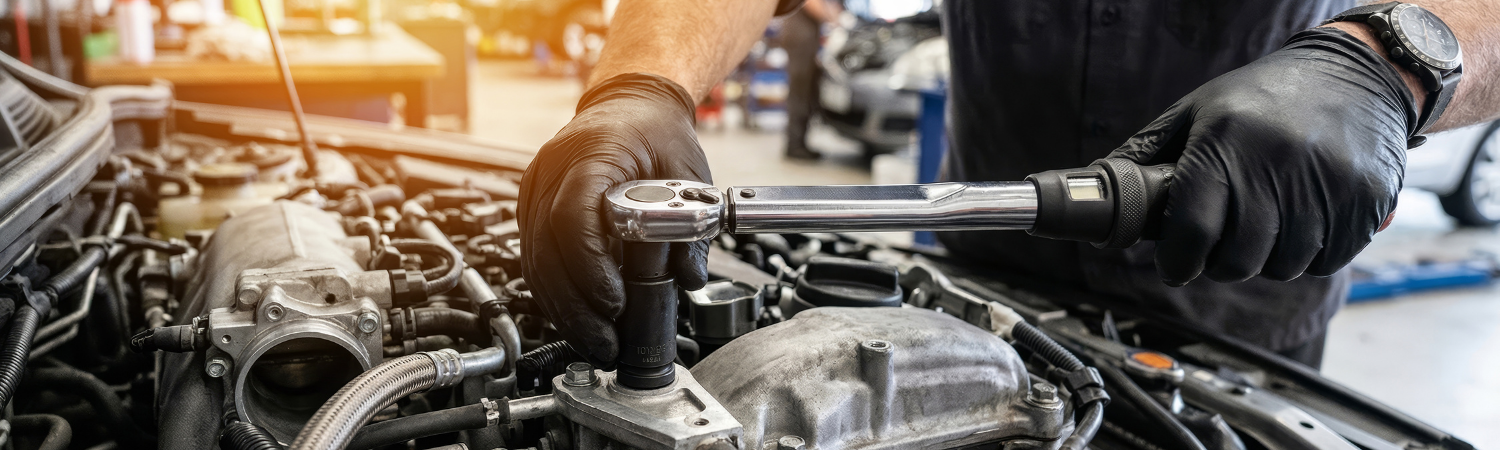
A bolt can look tight and still be wrong. That is why a torque wrench is one of the most important tools in automotive repair, equipment maintenance, machinery assembly, and many serious DIY jobs. Unlike a standard ratchet or wrench, a torque wrench does not simply turn a fastener. It helps you tighten that fastener to a specific amount of force.
That matters because many bolts are designed to hold parts together within a precise clamping range. Too loose, and the fastener can back out, leak, vibrate, or fail. Too tight, and you can stretch the bolt, strip threads, warp components, crack housings, or damage gaskets. A torque wrench helps you land in the safe middle.
Whether you are working on lug nuts, brake calipers, or shop machinery, knowing when and how to use a torque wrench can save money, prevent repeat repairs, and make your work safer.
JBTools.com carries torque wrenches, sockets, extensions, breaker bars, ratchets, adapters, and other hand tools that make accurate fastening easier for professional mechanics and home users alike.
What Is a Torque Wrench?
A torque wrench is a precision tool that applies a measured twisting force to a fastener. Torque is usually measured in foot-pounds, inch-pounds, or Newton-meters. In simple terms, it tells you how much rotational force you are applying to a nut or bolt.
Most torque wrenches look similar to a ratchet, but they have a scale, display, or preset mechanism that lets you control the final tightening force. Depending on the type, the wrench may click, beep, vibrate, bend, or show a reading when the selected torque value is reached.
The most common types include:
Click-type torque wrench: A popular choice for automotive work. You set the desired torque, tighten the fastener, and stop when the wrench makes a click.
Digital torque wrench: Uses an electronic display and may provide lights, sounds, vibration alerts, and angle measurement. This is useful for modern repairs that require high accuracy.
Beam-style torque wrench: Uses a pointer and scale to show torque as force is applied. It is simple, durable, and does not rely on a spring mechanism.
Preset torque wrench: Set to one torque value, often used in production, tire shops, or repeated service tasks.
Torque angle wrench or torque angle gauge: Used when a repair procedure calls for tightening to a torque value, then turning the fastener a specific number of degrees.
When Should You Use a Torque Wrench?
Use a torque wrench whenever a manufacturer gives a torque specification. That specification is not a suggestion. It is part of the design of the part, fastener, gasket, or assembly.
Common jobs that require a torque wrench include:
Lug nuts: Wheel fasteners must be tightened evenly and accurately. Uneven torque can contribute to vibration, warped brake rotors, damaged studs, or loose wheels.
Brake components: Caliper bolts, bracket bolts, and brake hardware often have specific torque values. Proper tightening helps keep braking components secure without damaging threads.
Engine work: Cylinder heads, valve covers, oil pans, intake manifolds, exhaust manifolds, spark plugs, and timing components all require careful torque control.
Suspension and steering parts: Control arms, ball joints, tie rods, struts, shocks, and axle nuts often need precise torque because they handle major loads.
Spark plugs: Over-tightening spark plugs can damage threads, especially in aluminum cylinder heads. Under-tightening can lead to poor heat transfer or compression leaks.
Drain plugs: Oil drain plugs, transmission plugs, and differential plugs can strip easily if over-tightened.
Motorcycles, ATVs, and bicycles: Smaller fasteners often require inch-pound torque values. Precision matters because lightweight components can be damaged quickly.
Industrial and equipment service: Pumps, compressors, machinery frames, flanges, and heavy equipment assemblies often depend on proper fastener clamping force.
A good rule is simple: if the part is safety-related, sealed by a gasket, connected to the engine, attached to wheels, or made of aluminum, look up the torque spec before tightening it.
Products Needed to Use a Torque Wrench Properly
A torque wrench works best when used with the right supporting tools. For most jobs, you may need:
Socket set: Use the correct size socket for the fastener. Six-point sockets are often best for high-torque work because they grip the flats of the fastener better than some twelve-point sockets.
Impact sockets: If you are using an impact wrench to remove fasteners, use impact-rated sockets. Do not use a torque wrench as an impact tool.
Extensions and adapters: Extensions help reach recessed fasteners. Use them carefully and keep the tool as straight as possible.
Breaker bar: Use a breaker bar to loosen stubborn fasteners before switching to a torque wrench for final tightening. A torque wrench should not be used as a breaker bar.
Ratchet or cordless impact wrench These can speed up removal and initial snugging, but final tightening should be done with a torque wrench.
Torque angle gauge or digital torque angle wrench: Needed for torque-to-yield bolts and procedures that specify degrees after initial torque.
Thread cleaner or tap and die set: Dirty or damaged threads can affect torque readings. Clean threads help produce more accurate clamping force.
Anti-seize or threadlocker: Use only when the service manual calls for it. Lubricants and thread treatments can change the relationship between torque and clamping force.
Repair manual or service information: Always confirm the correct torque specification for the exact vehicle, part, fastener, and thread condition.
You can find torque wrenches and many of these related products at JBTools.com, including hand tools, sockets, extensions, ratchets, shop supplies, and specialty tools for automotive and equipment work.
How to Choose the Right Torque Wrench
The best torque wrench depends on the job. The biggest mistake is using one wrench for everything. Torque wrenches are most accurate within their intended range, so a large foot-pound wrench is not ideal for tiny fasteners, and a small inch-pound wrench is not suitable for wheel lugs.
For lug nuts, truck work, suspension, and larger fasteners, a 1/2-inch drive torque wrench is usually the right choice. For brake calipers, engine accessories, intake parts, and general repair, a 3/8-inch drive model is often more convenient. For valve covers, small engine parts, interior fasteners, sensors, motorcycles, bicycles, and delicate components, a 1/4-inch drive inch-pound torque wrench is often the safer option.
Also consider whether you want a click-type or digital torque wrench. Click-type wrenches are reliable and easy to use, which makes them popular in garages. Digital models are helpful when you want an easy-to-read display, multiple units of measurement, audible alerts, memory features, or torque angle capability.
How to Use a Torque Wrench Step by Step
First, look up the correct torque specification. Do not guess based on bolt size alone. The correct value depends on the fastener, material, thread pitch, lubrication, gasket, and component design.
Next, choose the right torque wrench for the range. For best results, avoid using a wrench at the very bottom or top of its scale. Pick a tool where the target torque falls comfortably within the working range.
Inspect the fastener and threads. Clean off rust, dirt, oil, or debris unless the repair procedure says otherwise. Replace damaged bolts, stretched bolts, or single-use torque-to-yield fasteners when required.
Set the torque wrench to the proper value. On a click-type wrench, unlock the handle, rotate it to the correct setting, then lock it again. On a digital wrench, select the unit of measurement and enter the target value.
Install the correct socket and keep the wrench square to the fastener. Avoid pulling at an angle. A straight, steady pull gives the most consistent result.
Tighten smoothly. Do not jerk the wrench. Pull from the handle grip, not from the head or shaft. With a click-type wrench, stop as soon as you feel or hear the click. Do not click it repeatedly for “extra certainty,” because that can over-tighten the fastener.
When tightening multiple fasteners on the same part, follow the recommended sequence. Wheels, cylinder heads, valve covers, manifolds, and gasketed parts often require a crisscross or staged pattern. This helps distribute clamping force evenly.
For torque angle procedures, first tighten to the specified torque, then turn the fastener the required number of degrees using a torque angle gauge or digital angle wrench. Many modern engine fasteners use this method.
After finishing, return a click-type torque wrench to its lowest marked setting before storing it. Do not set it below the minimum scale marking. Store it in its case when possible to protect calibration.
Common Torque Wrench Mistakes to Avoid
One of the most common mistakes is using a torque wrench to loosen bolts. This can damage the internal mechanism and affect accuracy. Use a breaker bar for loosening, then use the torque wrench for final tightening.
Another mistake is ignoring lubrication instructions. A dry torque spec and a lubricated torque spec are not always the same. Adding oil, anti-seize, or threadlocker when it is not specified can cause over-tightening because lubricated threads reduce friction.
Using the wrong torque range is another issue. A 250 foot-pound wrench may not be accurate for a 15 foot-pound fastener. Use the proper wrench for the job.
People also forget calibration. Torque wrenches are precision tools. If one is dropped, used heavily, stored incorrectly, or has not been checked in a long time, it may no longer be accurate. Professional shops should follow a regular calibration schedule.
Finally, do not rely only on “feel.” Experienced technicians may have a good hand, but modern repairs often require exact numbers. A torque wrench takes the guesswork out of the job.
Why Proper Torque Matters
Proper torque protects parts, fasteners, and people. A wheel lug nut that is too loose can become a serious safety hazard. A spark plug that is too tight can damage expensive cylinder head threads. A valve cover bolt that is over-tightened can crush a gasket and create a leak. A suspension bolt that is under-tightened can move, clunk, or fail.
The goal is not simply to make a bolt tight. The goal is to create the correct clamping force. That clamping force is what keeps parts sealed, aligned, and secure under heat, vibration, pressure, and load.
A torque wrench is one of those tools that quickly pays for itself. It helps prevent broken parts, stripped threads, comebacks, leaks, and safety problems. For anyone who works on vehicles, equipment, or machinery, it belongs in the toolbox. When it is time to upgrade your setup, you can find torque wrenches and other essential tools for the job at jbtools.com.
FAQ
What size torque wrench do I need for automotive work?
Many automotive users benefit from having at least two torque wrenches: a 1/2-inch drive torque wrench for lug nuts and larger suspension fasteners, and a 3/8-inch drive torque wrench for brakes, engine parts, and general repair. For small fasteners, a 1/4-inch drive inch-pound torque wrench is also useful.
Can I use a torque wrench to loosen bolts?
No. A torque wrench should be used for tightening fasteners to specification, not for breaking bolts loose. Use a breaker bar, ratchet, or impact wrench for removal, then use the torque wrench for final tightening.
What happens if you over-torque a bolt?
Over-torquing can stretch or weaken the bolt, strip threads, crack parts, warp components, crush gaskets, or make future removal difficult. In some cases, the fastener may fail even though it felt very tight during installation.
Should lug nuts be torqued with the vehicle on the ground?
Lug nuts are often snugged while the vehicle is lifted, then final-torqued when the tire is touching the ground enough to prevent rotation. Follow the vehicle manufacturer’s recommended torque value and tightening pattern.
Do torque wrenches need calibration?
Yes. Torque wrenches can lose accuracy over time, especially if dropped, overloaded, used heavily, or stored incorrectly. Professional users should have them checked regularly. Home users should protect them carefully and consider calibration if accuracy is in doubt.
Where can I buy a torque wrench and related tools?
You can shop torque wrenches, sockets, breaker bars, ratchets, extensions, torque angle tools, and other automotive hand tools at JBTools.com. JB Tools offers options for professional mechanics, technicians, and DIY users who want accurate, reliable tools for repair and maintenance.